An Eternal Tradition. One Journey.
From fire altars that encoded the diagonal theorem centuries before Pythagoras, to infinite series that predated Newton and Leibniz by 300 years. Explore four Yugas of cosmic time. 224 interactive missions spanning creation to the present.
The Knowledge Gap
Many foundational discoveries were documented in India centuries — sometimes millennia — before they were independently developed or recognized elsewhere.
From Cosmic Creation to the Present
Satya Yuga (Puranic creation), Treta Yuga (the Ramayana), Dvapara Yuga (the Mahabharata), and Kali Yuga (recorded history through 14 Kalas + 4 Yuga Epics). Time is not a line — it is a wheel. The Yugas cycle eternally.
Satya Yuga
15 Puranic missions — avatars, creation, cosmic cycles
Treta Yuga
20 missions — from Rama's education to the ideal kingdom
Dvapara Yuga
25 missions — the great war, the Gita, Krishna's departure
Kali Yuga
14 Kalas, 151 missions — from the Vedas to 2026 CE
Sixteen Ways to Engage With This Tradition
Not a textbook. Not a documentary. An immersive digital Gurukul where you listen to ancient dialogues as podcasts, debate with AI peers, build fire altars, learn Sanskrit, meditate with OM drones, and journey through cosmic time.
Sacred Recordings & Podcasts
Listen to the actual dialogues of the Gita, Upanishads, and epics — brought to life as podcast episodes with distinct character voices, AI-generated portraits, and ambient OM drone. 38 episodes across 16 sacred texts, all from primary sources.
Dharma AI Guru
A fine-tuned AI teacher trained on sacred texts. Nine guru personalities — from the philosophical Vidyeshwar to the compassionate Karuna. Ask questions, challenge ideas, go five layers deep with the Socratic 5-Why method.
224 Interactive Simulations
Build Vedic fire altars with geometric precision. Map constellations. Sort philosophical schools. Debate in the Sabha. Every mission is a hands-on experience — not a lecture.
Peer Debate (Vaada)
Argue one side. Then switch and argue the other. A fellow Shishya (AI) challenges you in real-time. The Guru judges both. This is how the Naiyayikas trained — rigorous, adversarial, honest.
Learn Sanskrit (31 Lessons)
From Devanagari script to reading Upanishads in the original. 5 stages: Akshara → Shabda → Vakya → Shloka → Patha. Spaced repetition locks in what you learn. 150+ interactive exercises.
Primary Source Library
No summaries. No paraphrasing. Read the real texts: Baudhayana Shulba Sutra 1.48, Aryabhatiya 1.6, Sushruta Samhita. Sanskrit originals with verse-by-verse translation.
9 Immersive Voyages
Auto-narrated journeys with ambient soundscapes and real maps. Sail the spice routes, follow Rama’s exile, walk through temples of science, trace the rise and fall of empires. Choose your vehicle — chariot, ship, or rocket.
Cosmic Sound Engine
Six ambient soundscapes drawn from Vedic cosmology. OM at 136.1 Hz, Damru rhythms, Nasadiya silence, solar oscillation, music of the spheres. Study, meditate, or just listen.
Knowledge Map
An interactive map of Dharmic civilization. 45+ locations, 8 historical trade routes, maritime paths. See how knowledge traveled from Takshashila to Angkor Wat, from Nalanda to the world.
Cosmic Time Wheel
Visualize 4.32 billion years of Vedic cosmic time. Kalpas, Manvantaras, Yugas — see where human history fits within the cosmic breath of Brahma. Zoom from a single lifetime to the age of the universe.
Meditation Mode
Guided dhyana sessions with ambient OM drone. Select your duration, close your eyes, and let the sound carry you. Integrated with the Cosmic Sound Engine.
Daily Practice
One shloka per day. One challenge. One reflection. Spaced repetition review of Sanskrit you’ve learned. Dharmic calendar with festivals and observances. Dharma is not a subject — it is a practice.
Knowledge Base & Graph
A living encyclopedia of Dharmic knowledge organized as an interactive graph. See how concepts connect — Karma to Dharma to Moksha, Panini to Chomsky, Aryabhata to Copernicus.
Gurukul Classroom
Create a classroom, share a join code, and learn together. Teachers see a live dashboard of student progress. Built for schools, study groups, and families.
Sarvajña Degree
The ultimate mastery. Achieve Acharya level in all 18 Vidya paths — mathematics, astronomy, medicine, philosophy, architecture, ecology, consciousness, and more. Become Sarvajña: The All-Knowing.
Gurukul Pedagogy
Not a course — a Gurukul. Upanayana initiation, daily Svadhyaya, Vaada debates with side-switching, a Guru who remembers you, Dakshina after graduation. Ten traditional principles, digitally embodied.
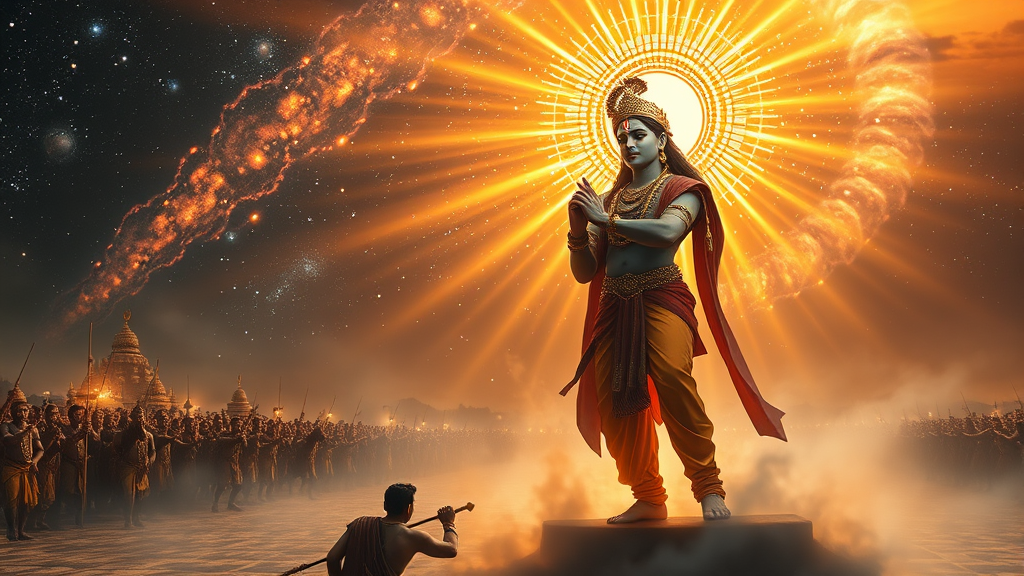
Hear Krishna Speak to Arjuna
This is what Sacred Recordings sound like. A full podcast episode of Bhagavad Gita Chapter 2 — where Krishna reveals the nature of the eternal Self to a despairing Arjuna on the battlefield of Kurukshetra. No sign-up required. Just press play.
Nine Journeys Through Time
Sit back and ride. Auto-narrated journeys with ambient soundscapes, maps, timelines, and a guide you can ask questions. Choose your vehicle.
18 Vidya Certification Tracks + Sarvajña Degree
Progress from Shishya to Acharya across 18 knowledge disciplines. Learn Sanskrit from Devanagari to reading Upanishads in 31 structured lessons.
Hear the Mathematics of Sound
The Sama Veda mapped musical frequency ratios over 3,000 years ago. Sa=1:1, Re=9:8, Ga=5:4, Pa=3:2. These are not arbitrary — they are the mathematics of consonance, discovered through devotion.
What Students Discover
Illustrative examples of the kind of reflections students share when encountering this knowledge for the first time.
“The Nasadiya Sukta ending with doubt is the most honest thing I have ever read in a sacred text. Every other creation story I know claims certainty. This one says 'perhaps even the Overseer does not know.' That takes more courage than certainty ever could.”
“I never knew the Pythagorean theorem existed 300 years before Pythagoras. This changes how I think about who 'discovers' knowledge. Baudhayana wrote it down in the Shulba Sutras for building fire altars. It was not abstract math — it was sacred geometry with a purpose.”
“The journey of zero blew my mind. Brahmagupta formalized it in 628 CE, then Al-Khwarizmi brought it to Arabia, then Fibonacci brought it to Europe. And we call them 'Arabic numerals.' The real story is so much more interesting than the label.”
“When I learned about the burning of Nalanda — one of the ancient world’s greatest libraries destroyed — I felt grief for knowledge I will never know existed. But then learning how the Bhakti saints carried everything forward in songs and poems... knowledge finds a way to survive.”
“Ramanujan saying that Namagiri gave him equations in dreams, and Hardy saying 'but the proofs are correct' — that tension between how knowledge arrives and how we verify it. I have been thinking about this for days. Both men were right.”
Begin Your Journey
विद्या धनं सर्वधनप्रधानम्
Knowledge is the greatest of all wealth.
Free
- Shruti Kala (8 missions)
- Swara Keyboard
- Daily Shloka
- Knowledge Cards
- Basic Simulations
- Mantra Player
- Show Me How guided walkthroughs
- Certification: Shishya level
Seeker
- All 4 Yugas + 14 Kalas unlocked
- 224 guided missions with interactive simulations
- 18 certification tracks
- 7 immersive voyages
- Knowledge Map
- Dharma AI Guru
- Structured Debate Challenges
- Daily Challenge + Reflection
- Progress Tracking & Assessment
- Teach What You Learn
- Earn Shishya & Adhyayin Certifications
Gurukul
- Everything in Seeker
- Read Original Sanskrit Texts (with translation)
- Sanskrit Mode + Glossary
- Knowledge Graph + Lineage Map
- Sanskrit Vocab Tracker
- Sarvajña Degree path
- Gurukul pedagogy (Upanayana, Dakshina)
- Priority AI Guru with memory
- Community Leaderboard & Classroom Mode
- Earn All 4 Certification Levels
- Downloadable digital certificates